
San Luis Obispo Public Records Boundaries
Access starts with the record set, not a broad name search. San Luis Obispo County keeps recorded instruments, parcel data, local vital certificates, election material, and many law-enforcement files. The Superior Court keeps its own case files. The City of San Luis Obispo maintains council, permit, planning, police, fire, and administrative material. The table leads with the practical question: which custodian controls the index or copy channel?
| Local record set | Office that keeps it | Web coverage | Ways to obtain it |
|---|---|---|---|
| Deeds, liens, maps, and recorded instruments | County Clerk-Recorder | Index from 1923; images from August 8, 2001 | Free index, paid web image, mail, email, fax, or counter |
| Civil, probate, and public criminal cases | San Luis Obispo Superior Court | re:SearchCA; public criminal cases filed after 2014 | Registered remote access, courthouse kiosk, or clerk copy request |
| Assessment and parcel records | County Assessor, GIS, and Public Works | Current property portal, LandUseView, and map index | Web search or office assistance |
| Birth, death, and marriage certificates | Public Health, Clerk-Recorder, or CDPH | No county Internet index | Office index search plus eligible copy request |
| Booking and custody material | County Sheriff or CDCR | Booking Log and CIRIS | Web lookup, agency contact, or records request |
| City actions, permits, and plans | City Clerk and city departments | Laserfiche, InfoSLO, and Citizen Connect | Web archive, department channel, or city request |
Open does not mean unrestricted. California closes or limits juvenile and adoption files, sealed cases, confidential marriages, protected voter addresses, driver information, and specified law-enforcement material. Some records remain viewable while copies are restricted. Others require proof that the requester belongs to an authorized class. Public records should therefore be checked against the law for that record type as well as the California Public Records Act.
San Luis Obispo Recorder Coverage
The County Clerk-Recorder holds official records back to 1850, but its web system does not expose that full span in the same way. The searchable online index begins in 1923. Purchasable and downloadable images begin August 8, 2001. An older deed can still exist even when no web image appears, so the fallback is an office search or a copy request through the recorder. This date split matters when a parcel, estate, lien, or family-history question reaches beyond the digital collection.
A web index entry is a finding aid. It can identify parties, dates, document type, and a recording reference without serving as the legal copy. The advanced Official Records Search shows how the county lets a user narrow a query.
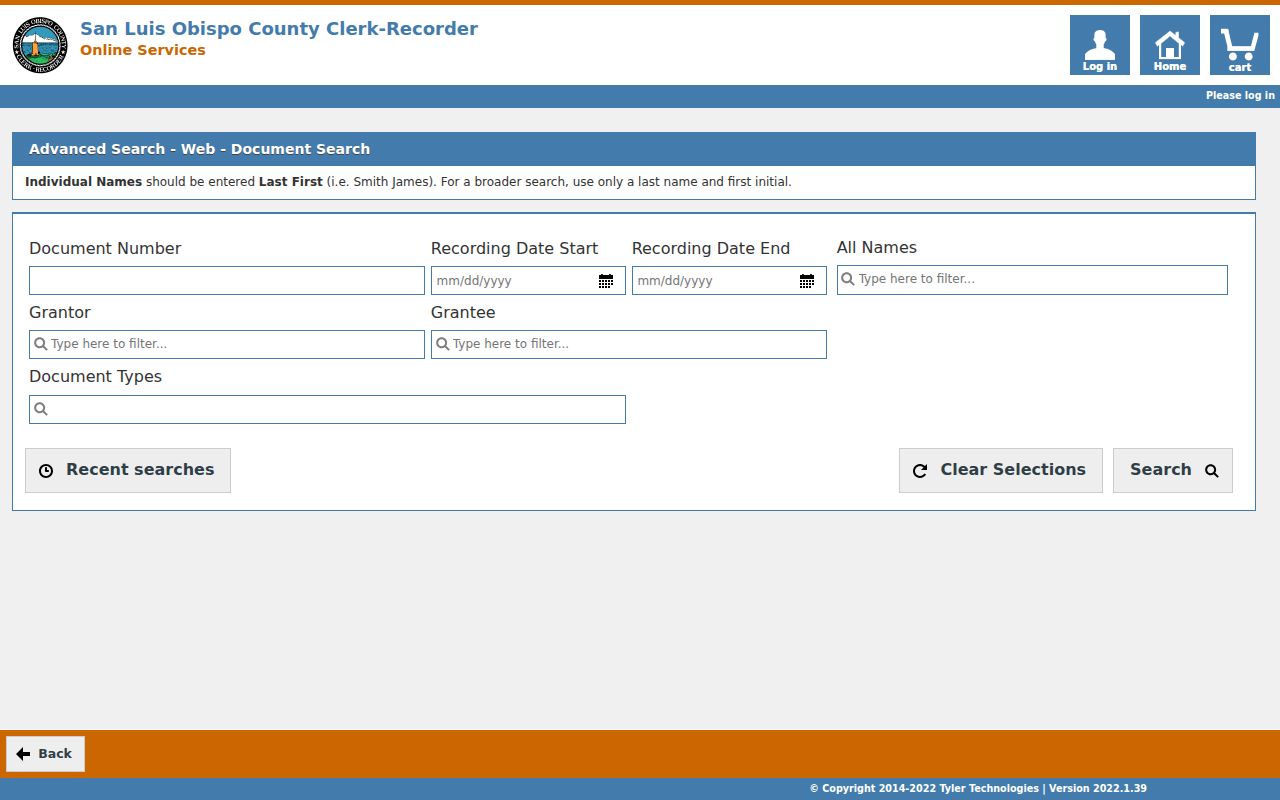
The form separates party names, grantor and grantee roles, document numbers, date ranges, and document types, which reduces false matches in a common-name search.
Note: Certified official-record copies must be issued on paper, while many newer noncertified images can be bought and downloaded through self-service.
Search San Luis Obispo Deed Index
The recorder offers five search modes: name, document number, document type, map book and page, and advanced search. A person-name query uses last name first, followed by the first name. A broad query can use a last name and first initial. Search help also supports exact phrases, required or excluded terms, starts-with searches, sounds-like matching, and marks for an uncertain letter. These controls are useful when old instruments contain spelling variants.
| Field on the recorder form | How it works |
|---|---|
| All Names | Optional primary name field; enter an individual as Last First. |
| Recording Date Start / End | Optional date range that limits the result set. |
| Document Number | Required in that mode; enter it with no commas, spaces, or hyphens. |
| Document Types | Optional dropdown or multiselect in document-type and advanced modes. |
| Grantor / Grantee | Optional advanced fields for the party giving or receiving an interest. |
| Map Book / Page | Separate mode for a known recorded map reference. |
A result can identify indexed names, the recording date, document number or book and page, document type, and whether an image is available for purchase. A grantor gives or transfers an interest; a grantee receives it. Those labels describe roles in the instrument, not a judgment about who owns the property today.
San Luis Obispo Records Custodians
The county seat concentrates several custodians in San Luis Obispo, but each desk has a distinct role. The Clerk-Recorder handles recorded documents, older county vital records, public marriage certificates, fictitious business names, and election filings. The Assessor maintains assessment and parcel information. Public Health issues birth and death certificates for county events within the last two years. Court files remain with the Superior Court, not the recorder.
County Clerk-Recorder
1055 Monterey Street, Suite D120
San Luis Obispo, CA 93408
805-781-5080
Recorded documents, vital records, clerk filings, and copy services
County Assessor
1055 Monterey Street, Suite D360
San Luis Obispo, CA 93408
805-781-5643
Property information, assessment records, maps, and parcel help
County Public Health
2191 Johnson Avenue
San Luis Obispo, CA
Recent county birth and death records
The Clerk-Recorder is open Monday, Tuesday, Thursday, and Friday from 8 a.m. to 5 p.m., and Wednesday from 8 a.m. to 4 p.m. Transactions end 30 minutes before closing. Calling first is wise when a request involves an older image, a certified copy, or an office-only index.
San Luis Obispo Court Record Channels
The Superior Court of California, County of San Luis Obispo uses re:SearchCA for remote public case access. A remote user must register, while courthouse kiosks do not require registration. That makes the kiosk a practical second route when an account cannot be created or a document is not available through the remote session. Public criminal cases filed after 2014 can be searched in re:SearchCA, and criminal documents can be viewed at onsite kiosks.
A docket may show a case number, title, case type, filing date, party names and roles, hearing dates, register of actions, disposition when open, and available document links. The docket is not always the case file. Criminal copy requests may take up to 30 days, and the court states a charge of $0.50 per page for criminal copies. Juvenile, adoption, sealed, and protected family-law information is not handled like an ordinary open case.
The Superior Court case lookup page explains remote sign-in and kiosk access. It also separates the attorney portal from general public access. Federal matters use the U.S. District Court for the Central District of California and PACER, not the county court system.
Note: A case number or narrow date range can help the clerk identify a file when the remote docket does not provide the needed document.
San Luis Obispo Vital Record Limits
Birth, death, and marriage indexes in San Luis Obispo County are not Internet-searchable. A person who wants to inspect those indexes must visit the Clerk-Recorder office and sign in with staff. This office-only rule is a key local limit. Public Health serves birth and death events from the last two years, while the Clerk-Recorder handles older county events and county marriage certificates. CDPH supplies a statewide mail route.
California distinguishes an authorized certified copy from an informational certified copy. Health and Safety Code § 103526 limits authorized copies to listed persons and agencies. A mailed, emailed, or faxed request for an authorized copy needs a notarized Certificate of Identity. Informational copies may be available to someone outside those categories, but they are marked as not valid to establish identity. Confidential marriage copies go only to a party to the marriage or a person with a court order; otherwise the office may issue a letter confirming that the record exists under Family Code § 511(c).
For recent county births and deaths, Public Health accepts online, in-person, and mail orders. Older birth and death records and county marriage certificates go through Clerk-Recorder copy applications, which support mail, email, and fax submission as documented on the forms. An index search itself still requires the San Luis Obispo counter.
Fee and eligibility warning. The county retains a vital-record search fee when no record is found and issues a no-record letter under Health and Safety Code § 103650.
San Luis Obispo Property Map Records
Property access spans three county systems. The Assessor Property Inquiry Portal handles current parcel and assessment research. Its visible controls include APN and situs, meaning the parcel number and the property's physical address. LandUseView can search an address or parcel number, zoom to the site, and display land-use context. The Public Works Map Index adds subdivision maps, parcel maps, tract maps, records of survey, County Surveyor maps, and corner records.
The Assessor Property Inquiry Portal is the first web channel for current parcel identity and ownership research.
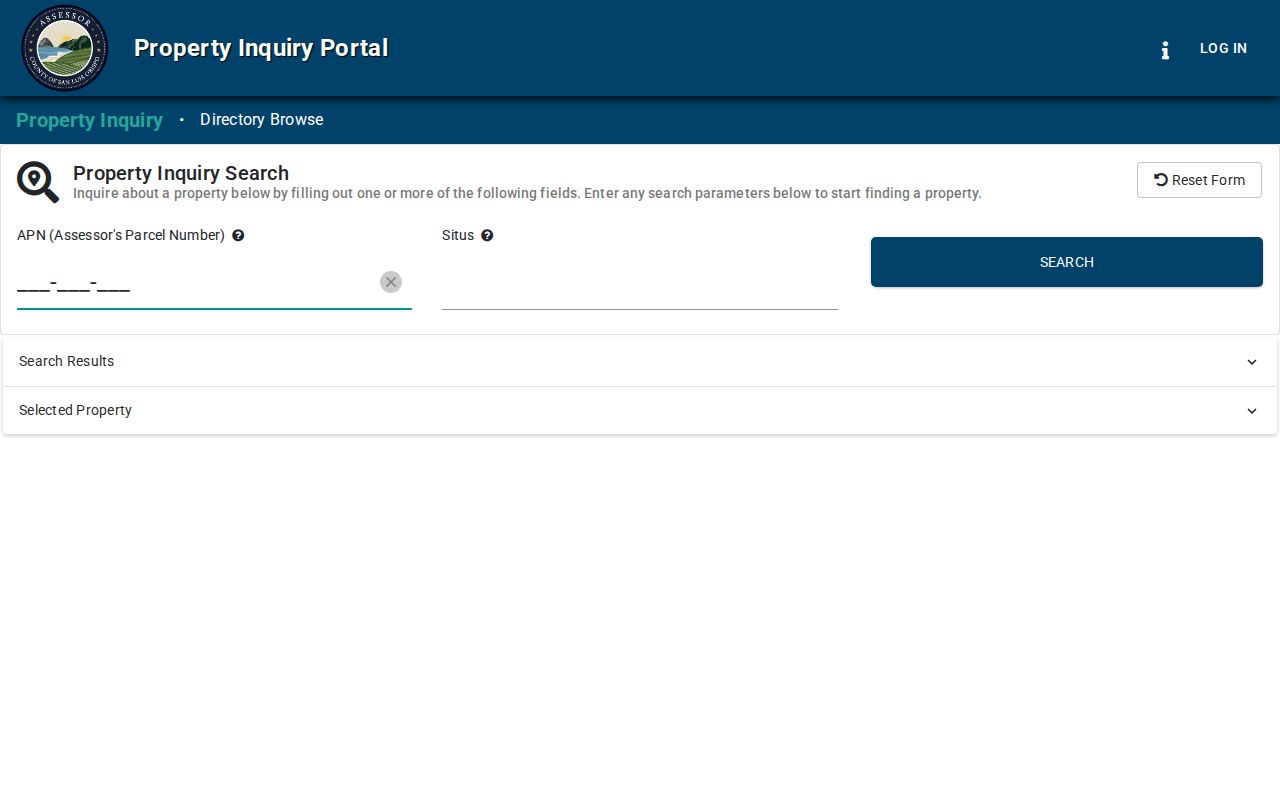
The portal is a JavaScript application, so office help remains the fallback when the page does not load or the public result lacks a needed assessment detail.
The county's LandUseView GIS provides the map-based route.

The GIS view helps tie a modern address to a parcel before a user moves to recorded maps or the deed index. For city parcels, InfoSLO and Citizen Connect add permit, planning, inspection, and code-case history by address, APN, permit, plan, or map browse.
San Luis Obispo Custody Record Access
The County Sheriff publishes a current or recent Booking Log, while records that are not posted can route through the Sheriff's public-record request email at sloso_pra@co.slo.ca.us. Arrest, custody, 911, body-camera, dash-camera, coroner, death-investigation, and warrant material may be held by the Sheriff-Coroner. Release depends on privacy and law-enforcement exemptions, so a request may produce a redacted response or a denial of protected portions.
State custody uses the California Department of Corrections and Rehabilitation's CIRIS lookup. When a person does not know the CDCR number or facility, the Identification Unit can be reached at 916-445-6713; a date of birth is needed for a common name. California's Megan's Law registry is separate and displays only the information allowed by Penal Code § 290.46 after the user accepts its warning.
These systems carry strict use limits. Registry data may not be used to harass, threaten, or commit an unlawful act. A local police report also has its own release rules, and San Luis Obispo Police does not send reports by fax or email. Its Records unit can be reached at 805-781-7311.
San Luis Obispo Records Copy Costs
Fees depend on the office and the product. A free index search can still lead to an image, paper copy, or certification charge. The Clerk-Recorder schedule effective July 1, 2026 through June 30, 2027 lists official-record copies at $7 for the first page, $1 for each added page, and $1 for certification. Credit-card payments add a $1.49 processing fee. Birth copies cost $34, death copies $26, and marriage copies $19 at the county level.
Map copies have different prices, including $16 for a full-size bond copy and $20 for mylar or vellum under the recorder schedule. A court copy uses the court's schedule instead. Requesters should ask for an estimate before ordering a large file and state whether a plain copy, certified copy, or inspection is needed. Under Government Code § 7922.530, an agency may charge direct duplication costs or another fee set by statute.
- Index
- A list that points to a recorded item; it is not the document image.
- Certified copy
- A paper copy authenticated by the custodian for official use.
- Custodian
- The office that keeps and responds for a record set.
- Exemption
- A rule allowing or requiring an agency to withhold protected material.
San Luis Obispo Digital Retention Update
San Luis Obispo updated its city records policy and retention schedule in 2025. The update addresses electronic-record conversion, retention periods, election files, city-owned property documents, GIS files, information-technology backups, and forms used to document destruction or conversion. It is a records-management change, not a promise that every city file will appear in a public web search.
The city's Laserfiche archive remains the online starting point for council packets, minutes, ordinances, resolutions, campaign disclosures, statements of economic interest, deeds, easements, and advisory-body material. If the requested item is absent, the city directs the requester to a formal request. Permit and planning records may instead sit in InfoSLO or Citizen Connect, and police or fire records use their department channels.
This division shows why retention and access are different. A schedule says how long the city keeps a class of records. The relevant portal or custodian determines where the public can inspect it. Copyright adds another local quirk: printed building-plan copies require permission from the owner, architect, or engineer, though in-person viewing can be available without those release forms.
Note: A San Luis Obispo mailing address at Cal Poly may fall outside city jurisdiction, making county or university files the more relevant source.
California Privacy Boundaries on Records
California law protects some data even when the surrounding record set is open. Social Security numbers, driver-license details, signatures, protected addresses, and specified victim information may be redacted. Safe at Home supplies a substitute mailing address for qualifying participants. Voter affidavit data is confidential under Elections Code § 2194 and is not an ordinary people-finding file.
Recorded documents may contain redactions or restricted material. Courts close juvenile, adoption, and sealed files, along with protected parts of some family cases. Law-enforcement agencies can withhold exempt investigatory or private details. A requester should describe the public portion sought instead of assuming that one protected field closes an entire file.
California privacy rights also allow consumers to seek deletion or correction from registered data brokers. Those rights do not erase an official deed, court order, or agency record that must be kept by law. The California Privacy Protection Agency's DROP system addresses broker-held data, while the custodian remains the source for correcting an official government record.
Request San Luis Obispo Public Records
The California Public Records Act, Government Code § 7920.000 and following, applies to identifiable nonexempt state and local agency records. A request may be verbal or written, though a written request gives both sides a clear description and date. Government Code § 7922.535 gives an agency 10 days to determine whether it holds disclosable material. Unusual circumstances can support a written extension of no more than 14 days. The determination date is not always the production date, especially for a large, stored, or heavily redacted file.
- Name the custodian. Send deeds to the Clerk-Recorder, cases to the court clerk, assessment files to the Assessor, and city material to the City Clerk or creating department.
- Define the record. Give a date range and useful identifiers such as a name, document number, case number, APN, address, contract, or RFP number.
- Choose a delivery path. Use the office's web form, email, mail, fax, or counter channel. The Clerk-Recorder form is helpful but not required.
- Ask about cost and format. State whether inspection, an electronic file, a paper copy, or certification is needed before paying reproduction charges.
- Review the response. If material is withheld, read the cited exemption. A narrower request may separate open pages from protected ones.
Inspection can avoid a large copy bill. Government Code § 7922.530 allows direct duplication costs or a fee set by statute, and an on-premises requester may use personal equipment to photograph or copy records when that will not damage them, expose a system, create an undue burden, or conflict with preservation needs.
The Clerk-Recorder form accepts contact details, the record description, a date range, and delivery choices for paper by mail or pickup and electronic delivery by fax or email. Certified documents are paper only. Requests may be mailed to 1055 Monterey Street, Suite D120, faxed to 805-781-1111, or delivered at the counter. Payment is due when reproduction is provided.
The Clerk-Recorder request page shows the office-specific form and submission rules.
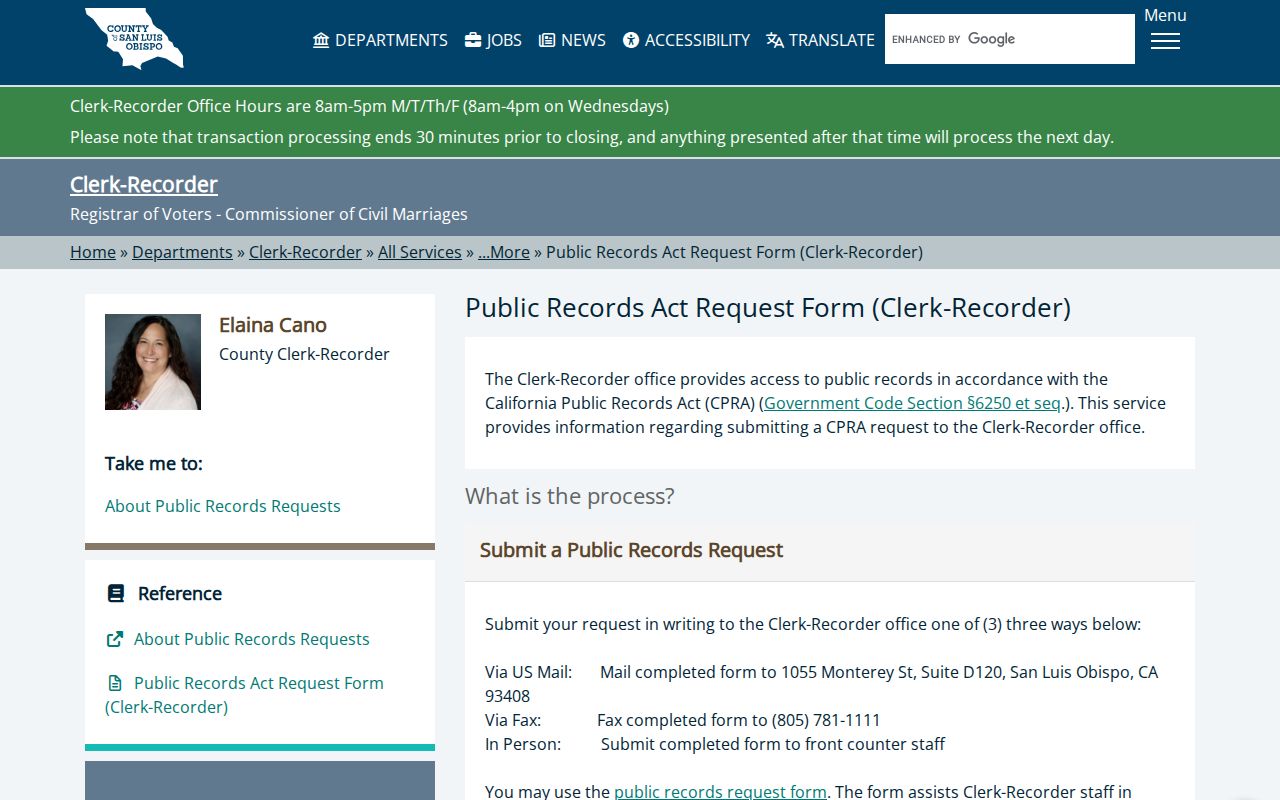
The form gives staff enough detail to route a request, and the county says it will forward a misdirected Clerk-Recorder request to the correct known department when possible.
Lawful personal use. Open government records support civic review, genealogy, estate work, and consumer safety. Never use them to stalk, harass, threaten, or harm another person.